 Shopping cart


THE RESPONSIBLE HERPETOCULTURE (RH) is an international approach aimed at forming and managing reptile and amphibian populations as part of collections operated by private breeders worldwide under commonly shared basic principles (pls, check the link for more details).
Within the context of global destruction of natural ecosystems, RH suggests ways for organizing and using breeders’ capacities and long-term unique experience from all over the world for biodiversity conservation. As a matter of fact, RH is not about mass production of common species for trade purposes; it is rather about maintaining numerous long-lasting heterogenous ex situ rare species breeding projects as an important aspect of many global conservation strategies.
Its results can be seen in dozens of successful species-saving reserve populations worldwide. The Kunming-Montreal Global Biodiversity Framework has 23 action-oriented global targets for urgent action over the decade to 2030.
The actions set out in each target need to be initiated immediately and completed by 2030. In this regard, task #4 fully corresponds to the global goals that the Responsible Herpetoculture Foundation and its main partners set for themselves, namely
“Ensure urgent management actions to halt human-induced extinction of known threatened species and for the recovery and conservation of species, in particular threatened species, to significantly reduce extinction risk, as well as to maintain and restore the genetic diversity within and between populations of native, wild and domesticated species to maintain their adaptive potential, including through in situ and ex situ conservation and sustainable management practices, and effectively manage human-wildlife interactions to minimize human-wildlife conflict for coexistence.”
All these achievements would not become a reality without an effective information exchange between private breeders, hobbyists, zoos and breeding centers + special international projects, involving all parts.
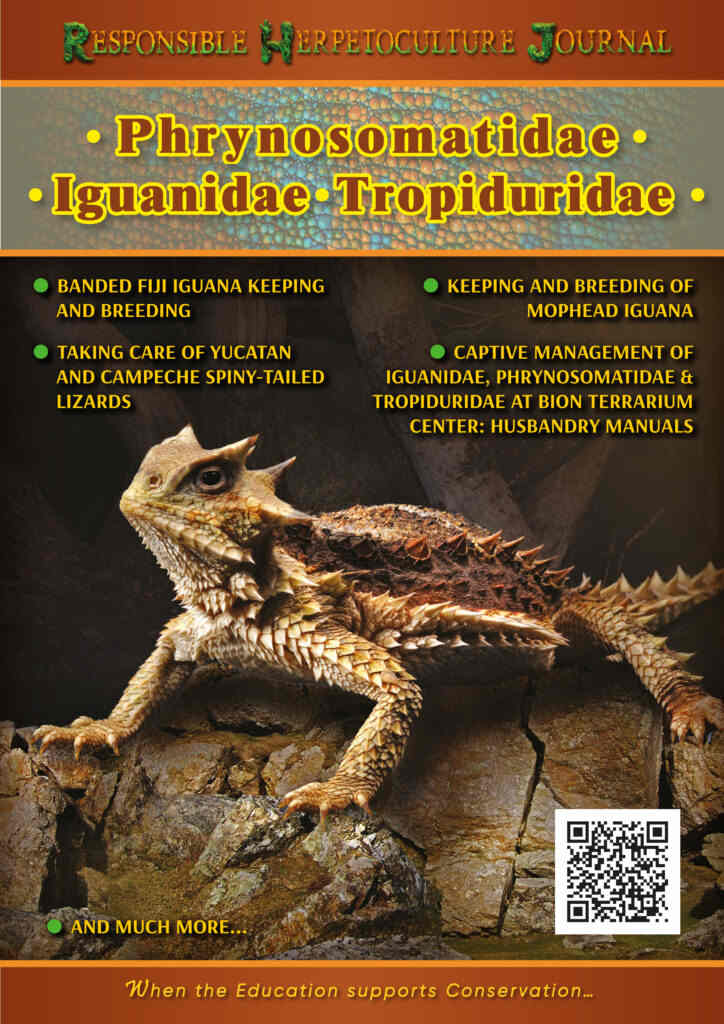
Sharing information on some key points in organizing husbandry and breeding, quarantine, curing of health issues, other approaches and aspects of Herpetoculture helps achieve a significant progress in general process. In this special edition we put together articles from RH Journal issues related to husbandry and breeding of Iguanidae lizards, that were kindly provided by reputable breeders from many countries.
Also, this publication contains husbandry manuals produced by BION Terrarium Center (BTC, Kyiv, Ukraine).
These manuals, though looking similar and being written in the same way and following the same logic, reflect many years of work of the BTC professional staff since the company’s foundation in 1993. These materials consist of summarized information for each Agamidae species that had been bred in the BTC.
Some of these species still exist and provide healthy captive-bred animals for ex situ breeding projects worldwide. Sharing these manuals is aimed at providing all interested parties with our experience that, as we sincerely hope, will help the future generations of herpetoculturists make their contribution to saving the world’s herpetofauna in their collections, exhibitions and rewilding or reintroduction projects raising their chances for success.