 Shopping cart




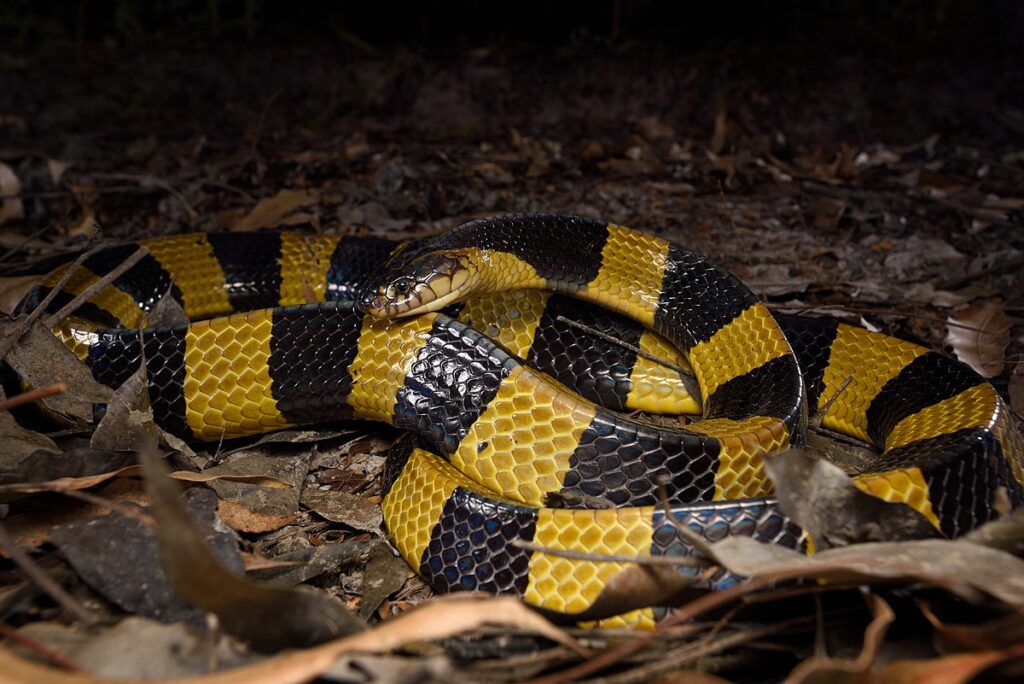
A recent study finds that the highly venomous banded krait (Bungarus fasciatus) is likely to be an assemblage of different species across Asia.
The study, carried out by Lal Biakzuala of Mizoram University and a team, sheds light on the genetic diversity and evolutionary relationships within the banded krait species.
Using a combination of genetic and physical structure analyses, they identified three distinct evolutionary groups of the banded krait occupying non-overlapping regions – Indo-Myanmar (east and north-east India and Myanmar), Sundaic (Greater Sunda islands), and east Asian (mainland Sundaland including southern China).
According to the authors, “We postulate the existence of at least three different taxonomic entities within the nomen B. fasciatus, and also confirm that populations in eastern India and north-eastern India are conspecific (belonging to the same species).”
The banded krait is a nocturnal, easily identifiable snake that inhabits different landscapes like agricultural lands, forests, and home gardens up to specific elevations. It has yellow (or cream) and black bands on its body.
The range of this venomous snake is widespread, from eastern India, across Nepal, Bhutan, Myanmar, and Bangladesh, further east into Laos, Vietnam, and China, and south into Thailand, Malaysia, and Singapore.
Read more info about this topic using the following link