 Shopping cart



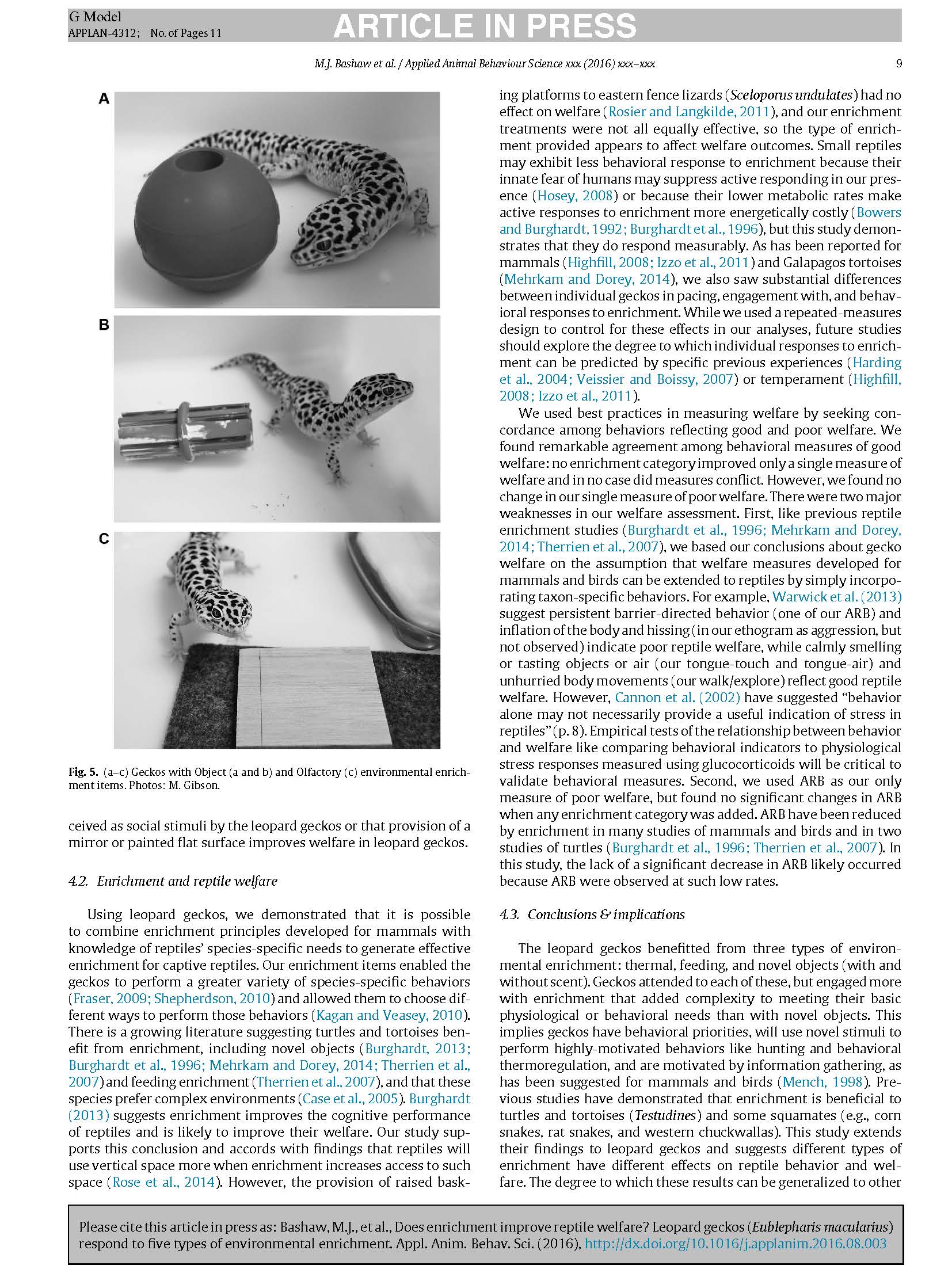
Abstract. Animal welfare is a high priority for pet owners and accredited zoos and aquariums. Current approachesto measuring welfare focus on identifying consensus among behavioral and physiological indicators ofpositive and negative emotions. Environmental enrichment is a common strategy used to improve thewelfare of captive animals. In enrichment programs, knowledge of an animal’s ecology and individual his-tory are applied to modify the animal’s current environment and management to increase environmentalcomplexity, make the environment more functional or natural, and increase behavioral opportunities.While enrichment techniques for primates and large mammals are well-studied, reptile enrichmenthas received little attention to date despite a few promising studies. In this study, we monitored theresponses of 16 leopard geckos to five types of enrichment (Thermal, Feeding, Olfactory, Object, andVisual) using a repeated-measures design. We measured both specific behaviors we expected to changein response to each enrichment type and four behavioral indicators of welfare: exploratory behavior,species-specific behaviors (behavioral thermoregulation and hunting), behavioral diversity, and abnor-mal repetitive behaviors. We found geckos interacted with all five types of enrichment at above-chancelevels (i.e., no 95% CIs for engagement time overlapped with 0 s). Geckos spent more time interact-ing with Thermal and Feeding enrichment than the other types (F(4,60) = 49.84, p < 0.001). Thermal,Feeding, Olfactory, and Object enrichments (but not Visual enrichment) changed specific relevant behav-iors (e.g., Thermal enrichment altered thermoregulatory behaviors, Wilk’s lambda = 0.25, F(3,13) = 13.39,p < 0.001) and improved behavioral indicators of welfare (e.g., behavioral diversity, Wilks’ lambda = 0.30,F(12,178) = 12.31, p < 0.001). These results suggest that geckos respond to environmental enrichment,that their responses are predictable based on their ecology, and that environmental enrichment improvesgecko welfare. As in mammals and birds, enrichments that address behavioral needs (here: thermoregu-lation and feeding) appear more effective than enrichments that simply provide novel stimuli to increaseexploration. The extent to which our results can be generalized to other reptile species awaits furtherstudy, but we suggest that enrichment should be more widely used to improve reptile welfare.
General Useful Articles