 Shopping cart



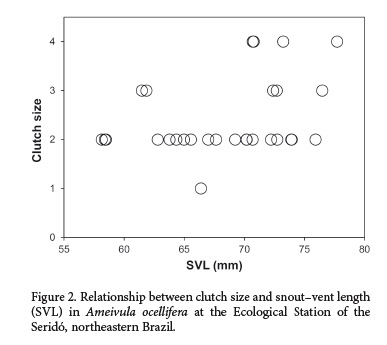
Abstract. This study provides ecological and behavioural data on the reproduction of the whiptail lizard Ameivula ocellifera in the Caatinga biome, northeastern Brazil. Our fieldwork consisted of monthly trips for three consecutive days, from January 2009 through June 2010. Incidental observations of reproductive behaviour were recorded in 2012, during a study on foraging behaviour. We found sexual dimorphism in maximum body size and head dimensions, with higher values in males. Clutch size averaged 2.41 ± 0.78 (range: 1–4) and was not correlated with female body size. Egg volume averaged 589.26 ± 77.27 mm³, egg mass averaged 0.594 ± 0.126 g, and relative clutch mass averaged 0.156 ± 0.053. Twelve of the 29 females in reproductive condition contained vitellogenic follicles and oviductal eggs or corpora lutea simultaneously. We registered reproductive females both in the rainy and dry seasons, and the proportion of reproductive females was significantly correlated with monthly rainfall, but not with air temperature. Average testis volume did not differ annually, and there were no significant relationships of testis volume with rainfall and air temperature. We registered a set of behavioural expressions of A. ocellifera related to courtship and mating; cloacal rubbing is among the most evident behavioural expressions involved in courtship, and males accompanying receptive females occurs before and after copulation. We conclude that A. ocellifera has a prolonged reproductive period in the Caatinga, is apparently continuous, but exhibits seasonal variations in reproductive activity. Rainfall unpredictability in the study area may be the major factor for the prolonged reproductive cycle. Most females produce series of clutches of two eggs each. The reproductive behaviour of A. ocellifera is very similar to North American whiptails, most likely reflecting a common phylogenetic origin among this lineage of lizards.
General Useful Articles