 Shopping cart


Abstract. Today, we know that new species are frequently available through the international pet
trade before they are recognized as new to science and prior to their formal description. In recent
years, this has also been the case in some monitors of the Varanus indicus and V. prasinus species
groups (i.e., V. melinus Böhme and Ziegler, 1997; V. yuwonoi Harvey and Barker, 1998; V. macraei
Böhme and Jacobs, 2001; V. boehmei Jacobs, 2003), which due to their colorful appearance and
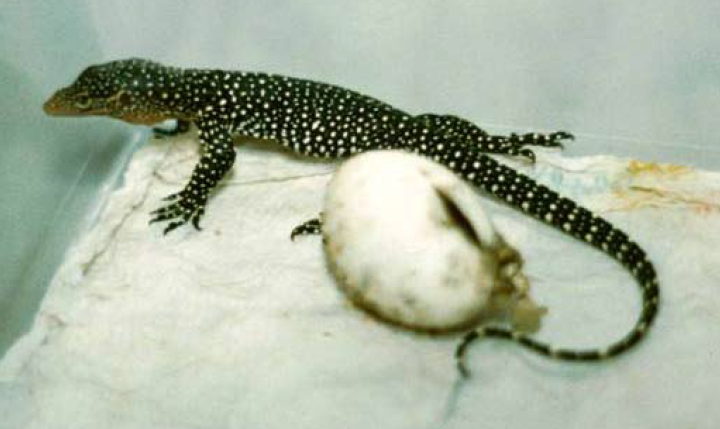
mostly moderate size, are focal species of monitor enthusiasts worldwide. Here, we can add another monitor lizard to this list of formerly unrecognized species. More than ten years before V. juxtindicus was originally described by Böhme et al. (2002), three adult specimens (allegedly traded as V. indicus) came into the possession of one of the authors (KW), but due to close phenotypic similarity with V. indicus their real taxonomic identity remained unrecognized until very recently. Between 1991 and 1995, ten clutches were produced resulting in eight hatchlings. Detailed information is provided about the conditions for the first successful breeding of V. juxtindicus in captivity. Moreover, the development of the juveniles is documented with emphasis on the ontogenetic change in color pattern.
CONSERVATION /ex situ/