 Shopping cart


Dear Friends,
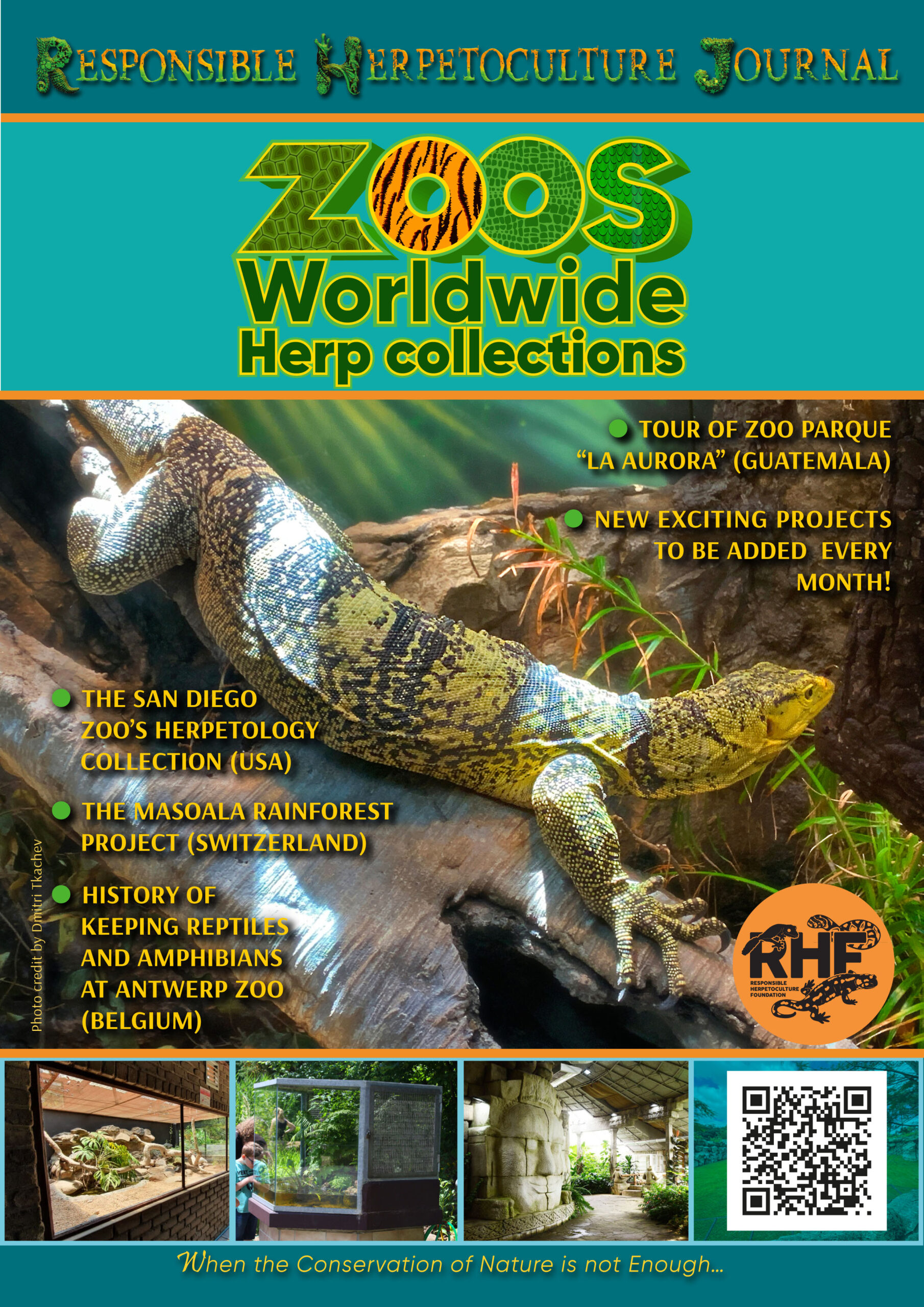
It is my pleasure to present to you our special issue—“Zoos Worldwide Herp Collections”.
Currently, there are about 10 000 zoos in the world; the best of them are important educational and conservation centers that provide real opportunities for conservation ex situ species that can no longer survive in natural conditions due to dramatic destructions of habitat.
Each article of this publication is unique in its own way as was written for us by zoo curators and keepers, and in some cases, these are interviews conducted by our editors during personal visits and acquaintance. Here you will find original materials only. At the same time, we have added special information about each zoo so that the reader can get a more complete picture of it.
I take this opportunity to once again express my personal gratitude to our authors and editors for their time, expertise, talent and support of this project.
Special thanks are due to Andrey Mazur, Publishing Editor, who has experience working as editor in a wildlife magazine and conducting a website about zoos.
In this issue you will find articles both about famous institutions, written by well-known experts (just look at the contents), and not so famous ones, but interesting in their own way. The geography of our publications includes Europe, Africa, Southeast Asia, North and South Americas and Australia, and we are glad that we can continue to develop this topic, receiving new amazing materials from around the world.
As Heiko Werning (Citizen Conservation) aptly said in his interview with RH Journal “Zoos have been working on this task (conservation ex situ) for decades. But the sheer mass of species involved make it necessary to significantly expand the capacity for such conservation breeding. Zoos alone can’t do this. On the other hand, we have a huge potential of private keepers who successfully propagate wild animals with a lot of expertise, passion, time and their personal resources.”
Today, collaboration between zoos and the private sector in breeding rare species of amphibians and reptiles leaves much to be desired.
Despite the fact that a number of zoos have achieved in these encouraging results, most of them simply have neither the place nor the staff.
A huge number of small amphibian and reptile species that are currently under threat of destruction, require an integrated approach and cooperation of these two sectors for saving them from extinction.
The identity of ex situ and in situ populations is the most important task aimed at preserving unique natural biodiversity and the opportunity for further reintroduction of any species into nature.
One of the branches of endeavor of the Responsible Herpetoculture Foundation is the Preservation Herpetoculture Alliance which seeks to develop and coordinate cooperative alliances between zoological, research institutions and private breeders to exchange information, build a body of knowledge for the captive maintenance and breeding of species and join programs to preserve species both in herpetoculture and in the nature.
We invite colleagues from different zoos involved in mutual conservation projects with responsible amphibian and reptile private breeders to exchange information, opinions and more active cooperation within RH conservation projects!
In my youth, I worked at a zoo as a keeper and as of now has visited more than 200 zoos all over the world.Ten years ago, I set up Ekzoland Zoo (now – Ekzo Zoo) in Kyiv; for 5 years I was the Executive Director of the Ukrainian Association of Zoos & Aquariums (UAZA).I am still in touch with my friends and colleagues at different zoos. I know and understand their tasks and problems and feel myself to be part of this community as well as herp community at the same time.
The special issue—“Zoos Worldwide Herp Collections”—will include both articles on this topic already published in the RH Journal, as well as new ones that will be added as they become available in our portfolio.Thus, customers of the “Zoos Worldwide Herp Collections”, which will be published in a digital version and regularly updated with new materials (including those not yet published in the RH Journal), will receive a dynamically developing project for their use. If you take the third level of RHF membership, you will have free access to this and other RHF special editions, including new articles not yet published in the RH Journal.
Cordially yours,
Dmitri Tkachev,
Editor-in-Chief, RHJ,
Founder, RHF